
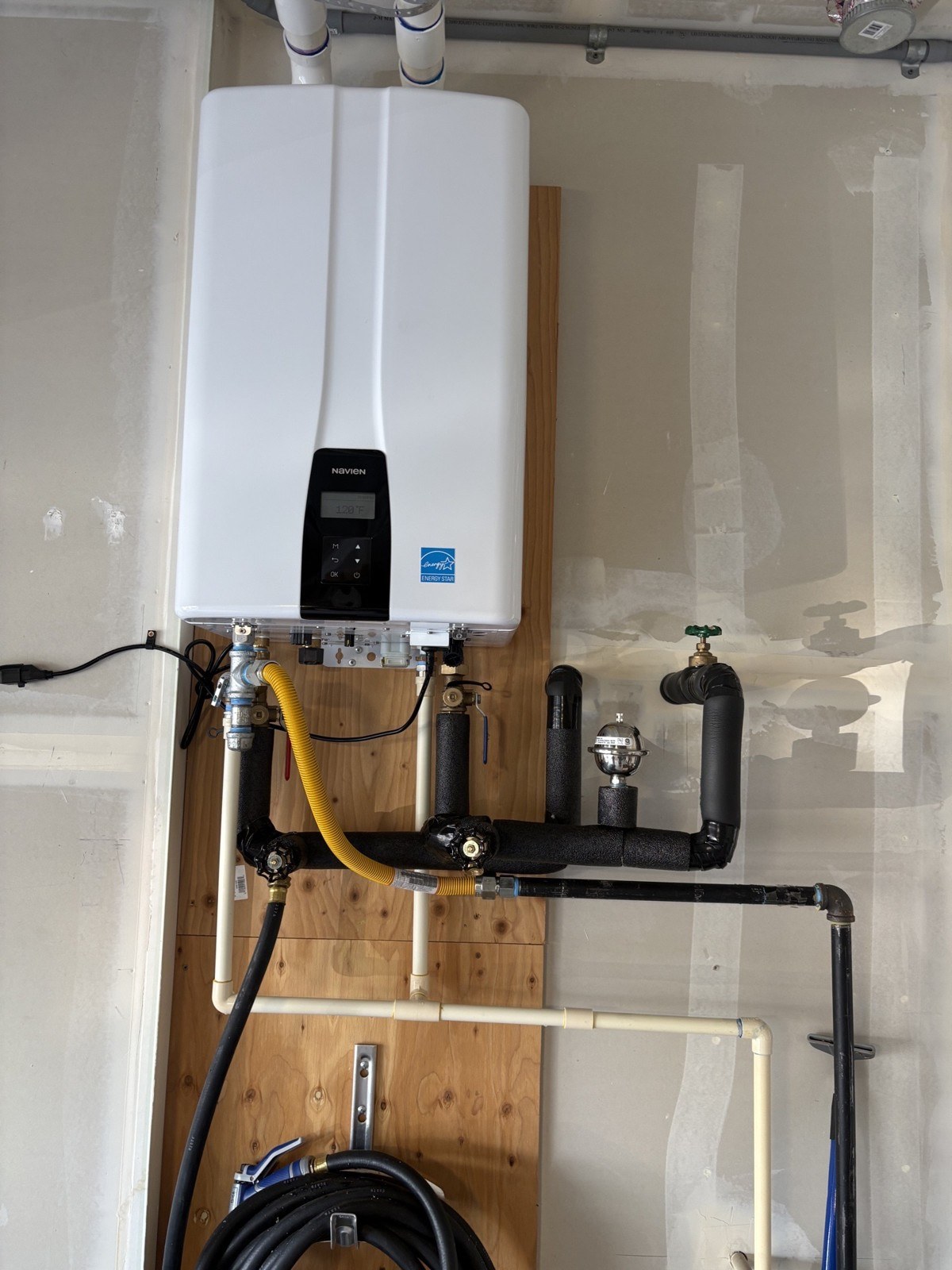
Nobody looks at a water heater until the shower goes cold, and the questions we get about them, from Fall City out to Maple Valley, come down to age, water and money. Here are the ones we hear most, answered from this year's jobs.
How long does a water heater last in the Snoqualmie Valley and on the Eastside?
A tank water heater lasts 8 to 12 years on soft Eastside city water and often less on a valley well, while a tankless runs 15 to 20 years if it is descaled on schedule. Outliers exist: in June we replaced a 65-gallon electric tank at Lake Alice in Fall City that had run 23 years.
A tank that old is on borrowed time. Sediment, a used-up anode rod and unmanaged pressure are what shorten the life.
How can I tell how old my water heater is?
Read the serial number on the rating plate. Rheem and Ruud put the month and year in the first four digits, Bradford White encodes the year as a letter, and most other makers print a date code; a search for the brand plus "serial number date" decodes it in a minute.
We also write the install date on top of every tank we set, as on the Fall City tank from this June.
Is a 15-year-old water heater worth repairing?
Usually not, unless the fault is a cheap external part on a tank that is not leaking: a thermocouple, an element, a thermostat or a relief valve. A tank that leaks from the seam or the bottom is finished, and money spent on a 15-year-old tank's burner is money you spend again at the replacement a year later.
A tankless is different: its parts are replaceable, so a 15-year-old unit from a maker that still supports it can be worth fixing. The discontinued Rinnai V75i we replaced in Fall City in July had run out of both.
Why do water heaters on well water fail sooner?
Because well water carries what city water has had filtered out: sand, iron and manganese that settle as sediment, consume the anode rod and scale a tankless heat exchanger. On a valley well a tank can need flushing twice a year, and a sediment filter ahead of the heater is the cheapest way to add years to it.
District water in Fall City, at about 4 grains per gallon with nothing added, is gentler, and Eastside city water is softer still, so a tank in Redmond or Bellevue mostly dies of age rather than minerals.
Does an expansion tank make a water heater last longer?
Yes, when it is working. A regulator or check valve makes the house a closed system, and the water that expands as it heats has to go somewhere; Washington's plumbing code requires an expansion tank for that reason. Without a working one, every heating cycle pushes the pressure up and stresses the tank, the relief valve and the fixtures.
An expansion tank also fails, often within five to ten years, and one hung off a horizontal pipe fails early and pulls on the line, as on our June Fall City job; the new tank went upright on rigid fittings on top of the heater.
What does it cost to replace a water heater on the Eastside?
On our 2026 invoices, a like-for-like 50-gallon propane or electric tank in the valley ran about $3,000 to $4,300 installed, and a like-for-like tankless swap about $4,900 to $7,600 from Fall City out to Maple Valley. Heat pump water heaters are quoted per house, less PSE's $1,000 rebate for its electric customers, or $1,100 if income-qualified.
What moves the price: fuel and venting, a gas line that needs upsizing, a new circuit, moving or raising the heater, and the expansion tank and permit where required.
Should I replace a tankless with another tankless?
Usually yes, if the house has been happy with it. The replacement is a planned job rather than a bolt-for-bolt swap, because venting, gas supply and water connections rarely line up between brands or generations. Budget for isolation valves under the new unit: they make every future flush a one-hour visit.
The May job in Maple Valley swapped a Noritz for a Navien, and the July job in Fall City a discontinued Rinnai V75i for a Rinnai RE180, both on new isolation valves.
Who issues the permit to replace a water heater, and do I really need one?
Yes, everywhere we work. Inside a city such as Redmond, Bellevue, Issaquah or Maple Valley, the city's building department issues the plumbing permit. In unincorporated King County, which includes Fall City, Preston and Lake Alice, Public Health Seattle & King County issues it, and since July 1, 2026 every replacement heater needs one.
For a like-for-like swap it is usually over the counter.
Talk to Someone Who Replaces These Every Week
Call 425-549-2400 or schedule an appointment.
More: water heaters · water heaters in Fall City · plumbing in Maple Valley · tank vs tankless, compared · signs your water heater is about to fail · water pressure in Fall City