
Fall is the one season when a plumbing checklist actually pays for itself. The hoses come off, the rains arrive, the water heater goes back to working hard, and anything you find now gets fixed on a calendar instead of at 2 a.m. in January. Here is the list we run on our own houses, in the order we run it, with the jobs that taught us each item.
1. Take the hoses off and look hard at the bibs
Disconnect every garden hose, drain it, and store it. A hose left on a bib holds water in the fixture, which is how a bib cracks in the first freeze, and on a frost-free bib the hose stops it from draining at all. Then look at the bib itself. A drip that tightening doesn't cure is internal wear, as a Duvall homeowner found in June. And check that what you have is actually a hose bib: in April we found a house near Lake Joy, outside Carnation, whose only outdoor tap on one side was a boiler drain under the floor, and replaced it with a proper bib on the wall. If yours has a small brass vacuum breaker on the spout, look for weeping there too; we replaced one in Fall City in July that high pressure had worn out.
2. Put a gauge on a bib before you put the hose away
A pressure gauge costs less than a hose and tells you more about your plumbing than anything else on this list. Thread it onto a bib with the house quiet and read it. Under 80 psi is within Washington's plumbing code, and 60 to 70 is where we set a regulator. In July a house in Fall City read 90 to 100 psi with no pressure-reducing valve at all; the water heater's relief valve had started discharging, which is how the homeowner noticed. On the Eastside, a Duvall tub faucet call in April opened with a 75 psi reading at the bib and ended with the regulator turned down. Our Fall City water pressure page explains what the number means.
3. Find your main shutoff and turn it
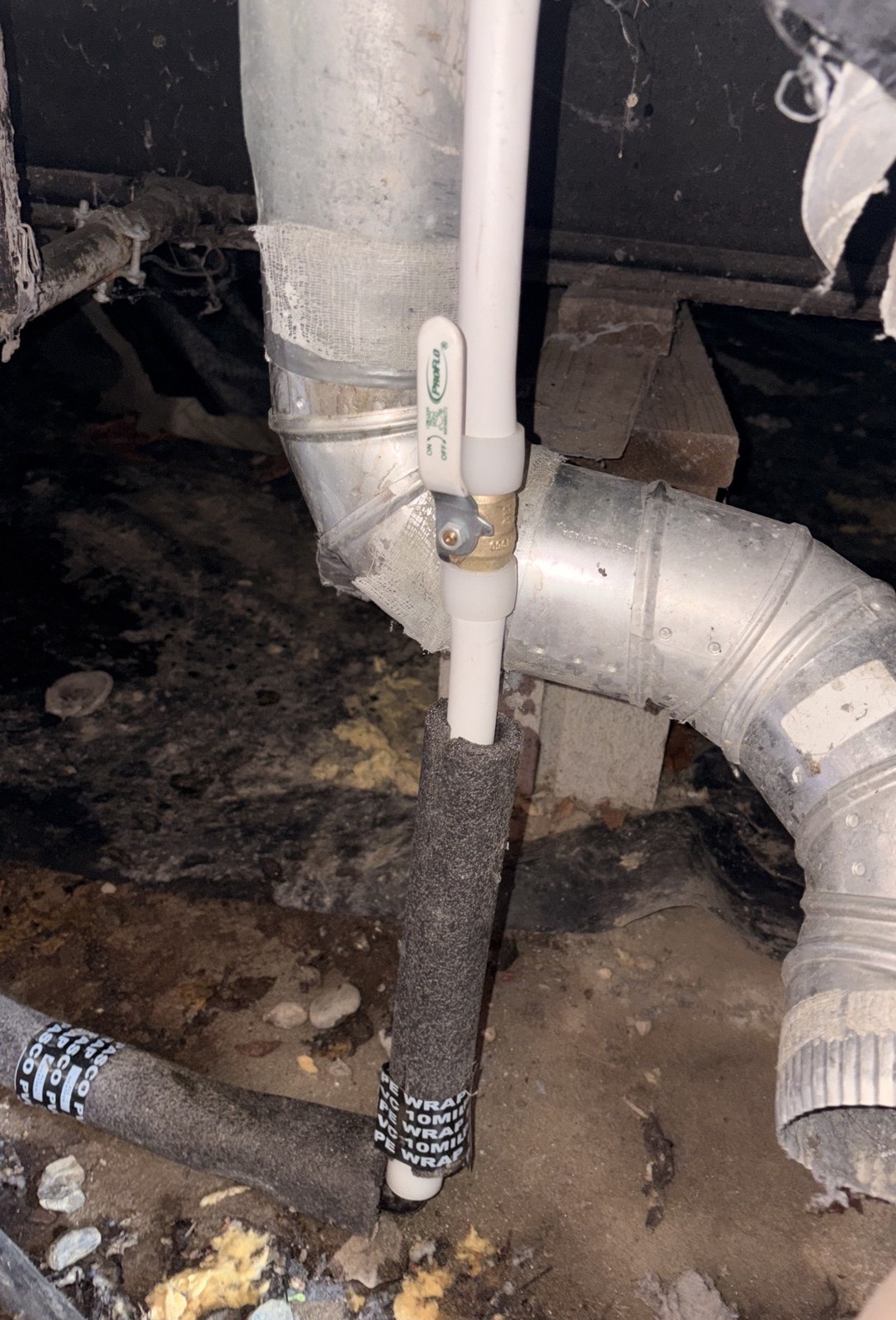
Before the season when pipes fail, know where the main shutoff is and confirm it works. Close it gently and open it again. A gate valve with a round wheel that won't move, or that moves and doesn't stop the water, should be replaced with a quarter-turn ball valve while nothing is wrong. Some houses have no shutoff inside at all: at the Carnation house above, Donald added one on the line into the house when he rebuilt the hose bib, so the plumbing can now be isolated from the crawlspace.
4. Look at the water heater, and not only to flush it
Everyone says to flush the tank before winter, and on valley well water that is still good advice, since sediment builds faster. But two other things matter more. First, the relief valve: if the discharge pipe is wet or crusted, the tank is reaching its pressure limit, and the cause is usually high incoming pressure or a failed expansion tank rather than the valve. Second, the expansion tank itself: tap it, and if it's heavy and sloshes instead of ringing hollow at the top, its bladder has failed. In April a Fall City homeowner's smart water monitor flagged high pressure; the answer turned out to be both a missing regulator and a dead expansion tank, and they were fixed in one visit.
5. Replace the shutoffs you've been ignoring
Every toilet and sink has a small supply stop behind it, and most of them have never been turned. The old multi-turn stops seize, and when a fixture fails you find out the stop doesn't work at the same moment. When we replaced two toilets in Brier in April, both shutoffs were replaced with quarter-turn stops and braided supply lines while the toilets were off. You don't have to wait for a new fixture: swapping the stops under the sinks and behind the toilets is a short visit, and it turns a future leak from a flood into a minute's work.
6. Crawl the crawlspace before the rains
Get under the house, or send us, before the ground is saturated. You're looking for wet insulation, a vapor barrier that's been shoved aside, standing water, and pipes that have sagged between hangers. Drain lines are the ones to check with a flashlight: in April a home inspection in Lake Stevens turned up a two-inch ABS drain that had cracked at an elbow, weeping quietly onto the vapor barrier, and it was replaced in under an hour. In Mountlake Terrace in June, a trickle at the taps traced to a galvanized supply line crusted at the elbow under the house. Neither would have been found from upstairs.
7. Test the sump pump and the drains that feed it
If your house has a sump, pour a bucket of water in the pit and watch the pump start, run, and stop. Then walk the outside: downspouts should discharge away from the foundation, and any drain that runs to the sump or to daylight should be clear of leaves. On the valley floor, where the water table rises with the river, a pump that's been idle since April is the thing between you and a wet crawlspace in November.
8. Valley homes: the well and the septic, before the wet season
If you're on a well, change the sediment filter now rather than when the pressure sags, and note the date on the housing. If you're on septic, and most of Fall City and rural Carnation and Duvall are, find out when the tank was last pumped. If it's due, book it before the rains raise the water table around the drainfield. The full version of both is in our well and septic guide.
Fall Plumbing Questions
When should I disconnect garden hoses on the Eastside?
Before the first hard freeze, which in the Snoqualmie Valley can come in October and closer to Lake Washington usually waits until November. The safe rule is to take the hoses off when you stop using them rather than when the forecast says frost, since a hose left on holds water inside the bib and defeats a frost-free fixture entirely.
Do frost-free hose bibs still need winterizing?
Yes, but the job is small. A frost-free bib keeps its valve seat inside the warm wall and drains the spout when closed, so it needs two things: the hose off, so the spout can drain, and a slight downward pitch so water doesn't sit in it. If one froze last winter, a hose was almost certainly left on.
How do I check my main shutoff valve without breaking it?
Turn it slowly. A ball valve with a lever should move a quarter turn without force. A gate valve with a round wheel should turn several times; if it's stiff, stop rather than force it, because a corroded stem can snap. Any valve that won't move or won't stop the water should be replaced before winter, not during.
Is fall a good time to check water pressure?
It's the best time. The hoses are coming off anyway, so a gauge on the bib takes a minute, and the water heater is about to work its hardest. A reading above 80 psi, or one that climbs overnight, means the regulator needs setting or replacing, and fixing it in October protects the heater, faucets and supply lines.
Our Recommendation
Do items 1 through 3 yourself this weekend; they cost nothing but an hour and a gauge. If the gauge reads over 80, the relief valve is wet, or the shutoff won't move, that is one visit for us, and it's cheaper in October than in January. Items 5 and 6 are worth doing once, properly, in any house older than twenty years. And if you're in the valley on a well and septic, item 8 is the one that keeps the others from mattering.
Get the Whole List Done in One Visit
Call 425-549-2400 or schedule an appointment.
More: outdoor faucet & hose bib services · water pressure services in Fall City · sump pump services · water heaters · well and septic plumbing in the valley