
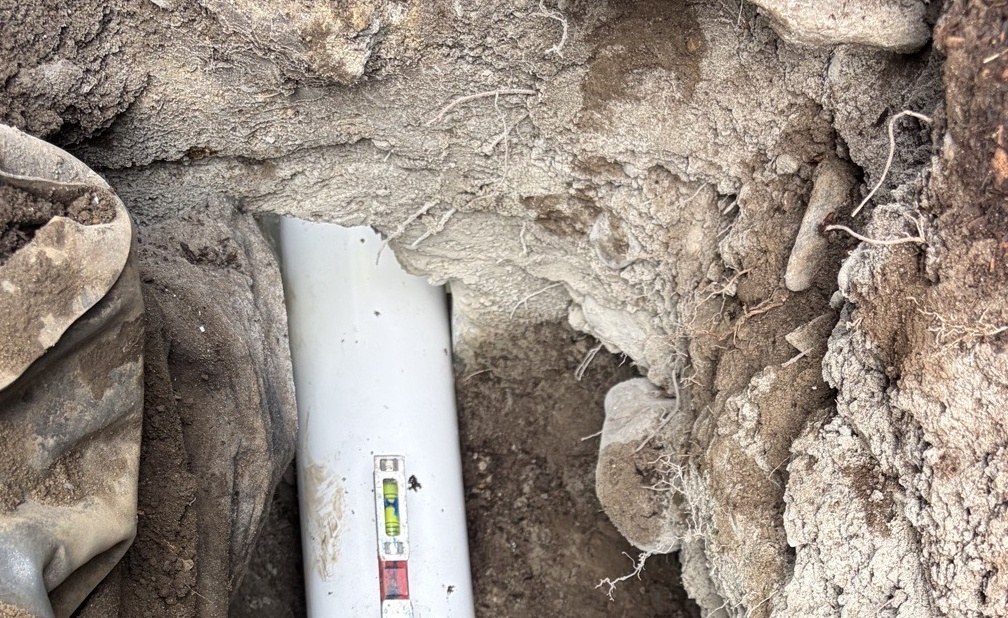
The pipe from your house to the septic tank fails in one of four ways: it loses its slope, it clogs at the tank inlet, it cracks or collapses, or it backs up because the tank or drainfield is full. A camera finds which. A clog is a cleaning; a pipe that has lost its slope or broken is dug up and replaced, usually in a day.
That is the short answer. The rest of this guide is how those four problems showed up on real valley and Eastside jobs in 2026, and how to tell which one you have.
What is the pipe between the house and the septic tank?
It is the building sewer: the single drain line that leaves your foundation and runs underground to the inlet of your septic tank. Every fixture in the house empties through it. It is yours to maintain, and it can be 40 feet long and only one to three feet deep, as one Carnation line this year was.
1. The pipe has lost its slope
The most common failure we dig up. A sewer line works by gravity, so it needs a steady fall all the way to the tank. When a section settles and slopes back toward the house, a "back-grade", solids stop moving, collect in the low spot and build into a blockage that comes back however often it is cleared.
- Fall City, September: Bradyn found about four feet of the main line, right before the septic tank inlet, severely back-graded. Solids were collecting and staying there. He cut out the section and relaid it at the right grade.
- Carnation, August: Ivan replaced the whole building sewer, about 40 feet of back-graded PVC from the ABS transition at the foundation to the tank, with new Schedule 40 PVC at about a 2 percent slope, a new cleanout brought to grade and the pipe bedded in crushed rock. A magnolia tree and its roots in the trench line came out with it.
- Carnation, September: Beau excavated the line from the house to the tank inlet and replaced it so it entered the tank on a proper grade.
How you know: the same drain backs up again weeks after it was cleaned, and a camera shows standing water in the pipe.
2. A clog at the tank inlet
The inlet baffle inside the tank is where the pipe ends and where debris catches first. A septic pumper is often the one who spots it.
- Fall City, July: a septic contractor pumping a tank noticed a possible clog in the line and called us that day. Mykal found the blockage right at the inlet baffle and cleared it, and quoted correcting the back-grade at the tank that had caused it.
How you know: the whole house drains slowly at once, and the septic company sees the line or the inlet backed up when they open the tank.
3. The pipe has cracked or collapsed
Some older lines were laid in thin-walled pipe, and roots and settling soil crack them over decades.
- East of Issaquah, October: Bradyn excavated about six feet of back-graded line and found the old pipe was a thin, brittle, conduit-like material, cracked and broken in several places. He replaced it with 4-inch Schedule 40 PVC at the right slope and added a two-way cleanout for future inspections.
- Near Ames Lake, Redmond, October: a camera showed the line completely collapsed and separated about five feet before the tank. The repair is told in our Ames Lake sewer spot repair story.
How you know: a camera shows the break; sometimes the yard above it stays wet or sinks.
4. The pipe is fine and the tank is full
Not every backup is the pipe's fault. When the tank is full, or the drainfield has stopped taking water, the line backs up even though it is sound.
- Carnation, February and March, and North Bend, September: three houses with backups had septic tanks that were full. In each case the tank was pumped and the line was cabled, and the drains ran again.
- East of Issaquah, October: during the pipe repair above, Bradyn saw that the tank's liquid level sat higher than the incoming pipe. The homeowner had the tank pumped, and the septic company agreed the drainfield might be draining slowly. Replacing the pipe could not fix that, so we recommended a drainfield inspection.
How you know: the tank is full when it is opened, or fills back up quickly after pumping.
What a repair costs
On our 2026 jobs, clearing a backup caused by a full tank, with the tank pumped and the line cabled, ran about $2,000 to $2,600 with tax. Replacing a back-graded or broken section of the line to the tank ran about $7,500 to $12,000, depending on its length and depth, what is in the way of the trench and what has to happen inside the house at the same time. Clearing an inlet clog alone can cost a few hundred dollars.
Frequently Asked Questions
Who should I call first, a septic company or a plumber?
If the tank has not been pumped in years, the septic company, because a full tank is the cheapest thing to rule out. If the tank was pumped recently and the house still backs up, a plumber with a sewer camera, because the problem is likely the pipe between the house and the tank.
We work alongside septic companies on both kinds of call.
Do I need a permit to replace the line to my septic tank?
Usually. In unincorporated King County, Public Health Seattle & King County oversees on-site sewage systems, and inside a city the city's building department may issue the side sewer or plumbing permit. Which one applies depends on where the house is and whether the tank itself is touched. We tell you before we dig.
Will the yard be torn up?
A trench about two feet wide along the line, one to three feet deep in most valley yards, refilled with the native soil afterward. Lawn, landscaping and hardscape are usually restored by the homeowner or a landscaper. Most replacements are one working day, with the house's drains out of service while the line is disconnected.
Can I use my toilets while the line is being replaced?
No. While the pipe is disconnected, nothing in the house can drain: toilets, sinks, showers, the washing machine and the dishwasher all wait. We plan the cut so the system is back in service before the crew leaves for the day.
Our Recommendation
Do not keep paying to clear the same backup. If a line to the septic tank clogs twice in a year, have it scoped. If the camera shows standing water or a break, replace that section at the right slope with a cleanout, as we did in Fall City, Carnation and east of Issaquah this year. And whenever the line is open, have the tank's level checked, because a new pipe cannot drain into a full tank.
Backup on a Septic System
Call 425-549-2400 or schedule an appointment.
More: septic-safe plumbing habits · sewer line repair in Fall City · sewer line repair in Carnation · why sewers back up in the rain · well and septic plumbing in the valley