
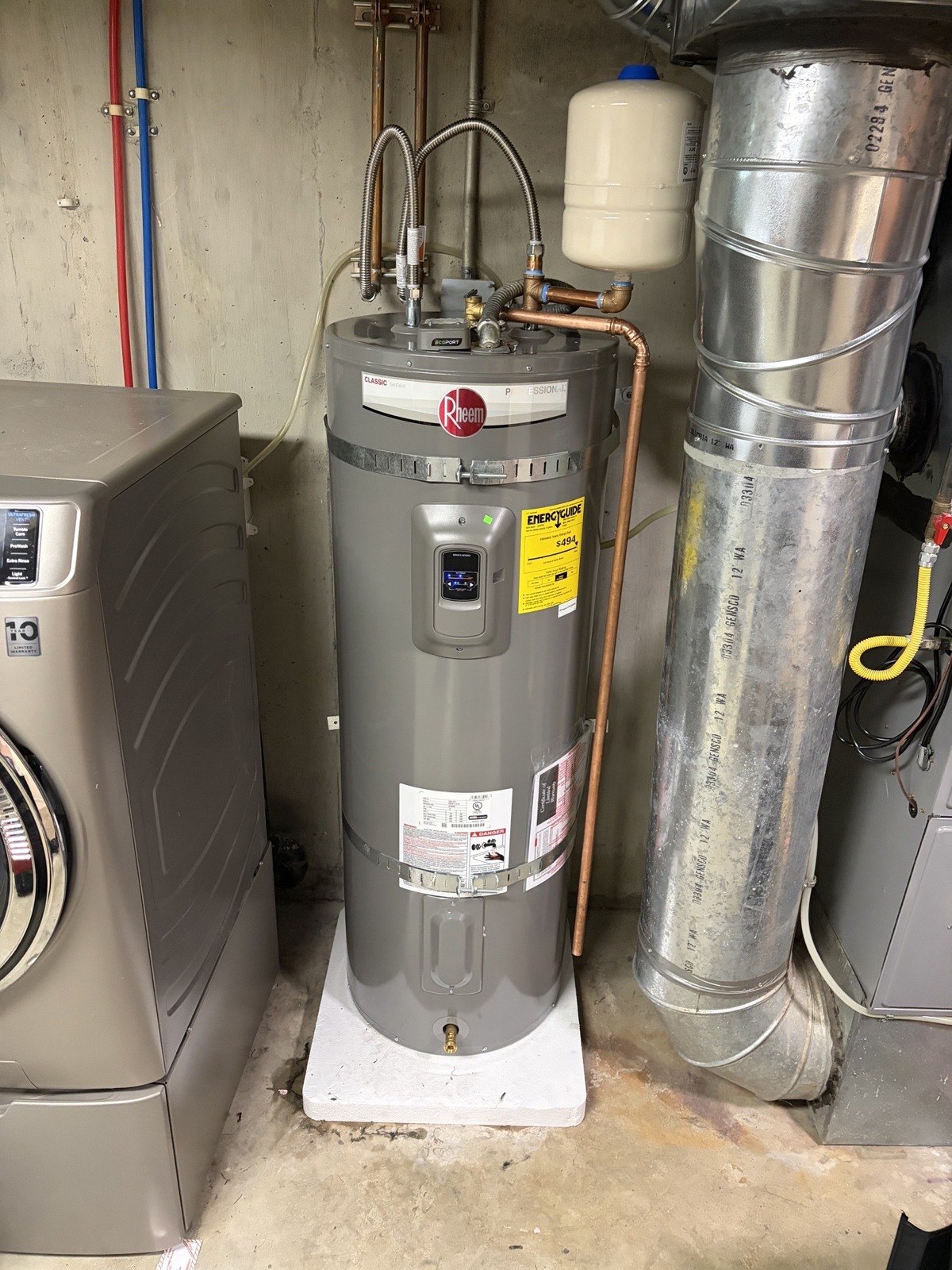
A heat pump water heater is the better choice for most electric homes in Washington with room for it: a garage, basement or large utility room. It uses far less electricity than a standard electric tank, and PSE or Seattle City Light rebates cut the price. A gas or electric tank still wins in tight closets and for a same-day emergency swap.
That is the short answer. The rest of this post is how we get there on real jobs, from Fall City to Bellevue.
What is the difference between a tank and a heat pump water heater?
A standard tank heats stored water directly, with a gas burner or electric elements. A heat pump water heater is an electric tank with a small heat pump on top that pulls warmth from the surrounding air into the water, using the elements as backup. Moving heat takes far less electricity than making it.
1. Running cost: heat pump wins on electricity
A heat pump water heater uses a fraction of the electricity of a standard electric tank to heat the same water, because most of the energy comes from the air around it. For a house that already heats water with electric elements, that is the biggest saving in the decision. Against a gas tank the gap is smaller and depends on your gas and electric rates, so we compare the two for your house rather than promise a number.
2. Up-front cost and rebates
A heat pump unit costs more to buy and to install than a tank. Rebates close a good part of that gap in our area:
- Puget Sound Energy pays $1,000 back on a qualifying Tier 3 or Tier 4 heat pump water heater installed on or after January 1, 2026, or $1,100 through its income-qualified Efficiency Boost program, for heaters running on PSE electricity. A participating installer can apply it as an instant rebate; otherwise the application goes in within 30 days.
- Seattle City Light customers get $750 on a Tier 3 or Tier 4 ENERGY STAR heat pump water heater, through a contractor, a store coupon or a rebate form within 93 days.
For comparison, the tanks we replaced in 2026 ran about $3,200 to $4,100 with tax for a 50-gallon gas or electric tank done like for like, and $6,000 to $6,600 for a 75-gallon gas tank. In June, Caleb replaced a gas water heater in a Bellevue house near Lake Hills with an 80-gallon Rheem ProTerra hybrid the homeowner had bought, capped the old gas line, and had a licensed electrician run a new dedicated 30-amp circuit. The plumbing and electrical together came to roughly $6,400 before tax, before any rebate.
3. Space, air and noise
This is where most heat pump decisions are made. The unit needs air to draw heat from: a garage, an unfinished basement, or a large utility room. It cools and dries the space around it, which is welcome in a garage and unwelcome in a small closet off a bedroom. The fan and compressor make a low hum, about like a refrigerator. And it makes condensate, so it needs a drain nearby.
The tight closets we see in condos near Totem Lake, or the alcove under the stairs in an older Seattle house, often rule a heat pump out on space alone. That is fine: a standard tank fits where a heat pump will not.
4. Electrical service
Most heat pump water heaters need a 240-volt circuit, often a dedicated 30-amp one, as in the Bellevue job. Replacing an electric tank usually means the circuit is already there. Replacing a gas tank means a new circuit, and in an older house with a full panel, possibly more electrical work. We check the panel at the quote visit.
5. Recovery and family size
A heat pump heats water more slowly than a gas burner. In normal mode it leans on the heat pump and saves the most; in high-demand mode it brings the elements in and recovers faster but saves less. That is why we often size up: an 80-gallon heat pump where a 50-gallon tank used to be, as both the Bellevue house and an 80-gallon Rheem we serviced near Snoqualmie had. A big family that empties a gas tank every morning may still be happiest with gas.
6. Replacement in an emergency
When a tank fails on a Tuesday morning with water on the floor, a like-for-like tank is the fastest way back to a hot shower. PJ replaced a 23-year-old leaking gas tank in Duvall with a new Rheem the same day in July, and that is the right call when a household cannot wait. A heat pump is easiest to do well as a planned swap, when the heater is getting old but has not failed, so there is time to sort out the space, the circuit and the rebate.
7. Water and maintenance
Much of our area runs on very soft water: Seattle's Tolt and Cedar supply in Seattle, Kirkland and Duvall. Soft water leaves little scale in any tank but wears the sacrificial anode faster, so every tank, heat pump or not, needs its anode checked. A heat pump unit also has an air filter to clean and a condensate line to keep clear. On wells out in the valley, sediment is the bigger issue, and flushing the tank matters more than the type.
Heat pump units are still plumbing. In November, PJ found an 80-gallon Rheem heat pump water heater near Snoqualmie making no hot water. The heater was fine: a leak on the hot water recirculation line in the crawl space was letting cold water into the hot side. He cut out the damaged section of PEX and replaced it.
Frequently Asked Questions
Can I put a heat pump water heater in a closet?
Usually not a small one. A heat pump unit needs a good volume of air around it, or ducting or a louvered door, because it pulls heat from that air and cools the room. A garage, basement or large utility room suits it. In a tight closet, a standard tank is often the practical choice.
Does a heat pump water heater work in a cold garage?
Yes, within limits. It runs as a heat pump in the temperature range its manufacturer lists and switches to its electric elements when the air is too cold, so you keep hot water, just with less saving on the coldest days. Western Washington garages rarely stay below freezing for long, which makes them a reasonable home for one.
What rebates are there for heat pump water heaters near Seattle?
PSE customers get $1,000 back on a Tier 3 or Tier 4 unit installed on or after January 1, 2026, or $1,100 through Efficiency Boost, if the heater runs on PSE electricity. Seattle City Light customers get $750 on a Tier 3 or Tier 4 ENERGY STAR unit. Your electric utility decides which one applies.
Is it worth switching from gas to a heat pump water heater?
It can be, especially if you are removing gas from the house or your gas tank is near the end of its life. The switch costs more than a like-for-like tank because of the new circuit and capping the gas line, as in the Bellevue job, so plan it before the old tank fails. We price both side by side.
Our Recommendation
If you heat water with electricity and have a garage, basement or roomy utility room, replace your next tank with a heat pump water heater, and plan it before the old one fails so the rebate and the circuit are sorted. If you are on gas, have a tight closet, or the tank has just failed, a like-for-like tank is the honest answer, and there is no shame in it. Either way, a new tank gets new supply lines, an expansion tank, straps and a code-compliant relief line, and we figure in any rebate at the quote.
Talk Through Your Water Heater
Call 425-549-2400 or schedule an appointment.
More: water heater services · tankless vs tank water heaters · water heater questions answered · water heaters in Duvall · water heaters in Kirkland · do you need a permit to replace a water heater in King County?